XABCD TRADING
Difference Between XABCD Patterns vs Elliott Wave
Subscribe
to get alerts to our next blog post!
Comparing XABCD Patterns to Elliott Wave
We've recently spoken to a bunch of Elliott Wave traders, and have heard many have been moving in droves to use patterns. A large portion of those have turned specifically to XABCD Trading and these patterns specifically. But why? When comparing harmonic patterns vs elliott wave, what are the key differences that matter to traders?
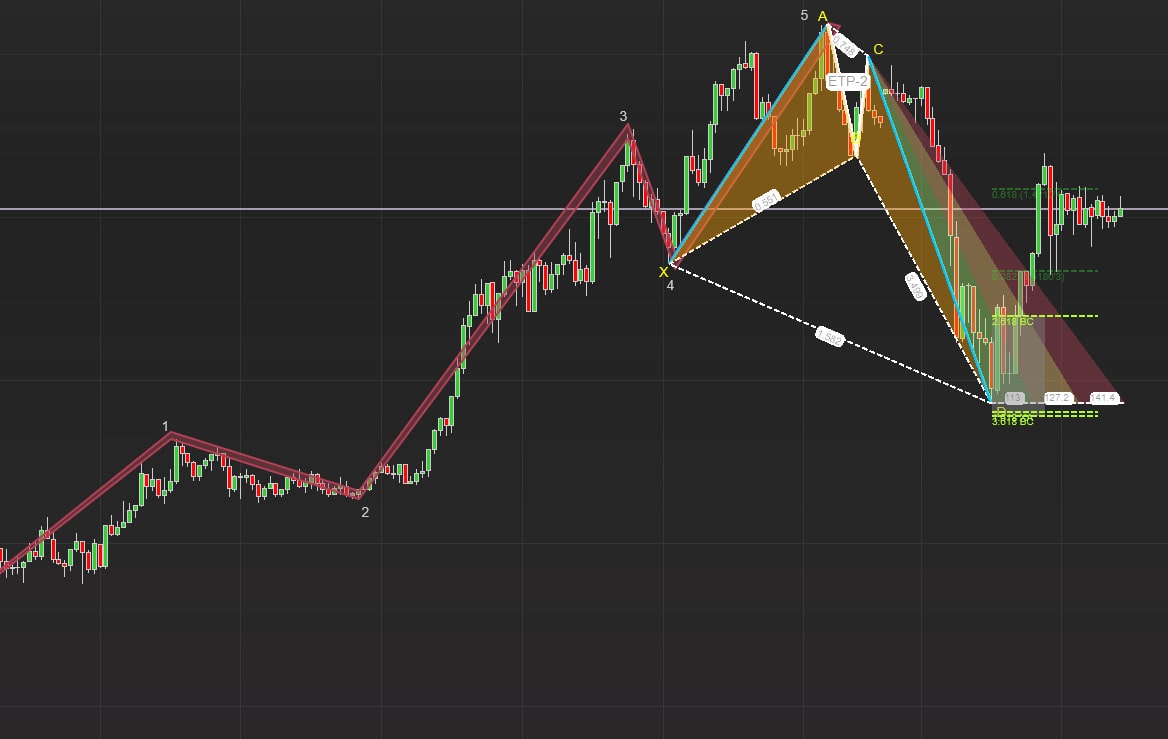
There are many differences to point out between Eilott Wave traders and XABCD Pattern traders that we'll go through below. However, one that is really important to point out first is that Elliott Wave traders look for patterns in trends only. Very few have talked about any "end of trend trades" as they are often avoided because their outcome is not as predictable. Many would agree that the market will range 70% of the time and trend 30%. With that being said, Elliot Wave traders should only be trading 30% of the time and this could potentially lead to a lot of missed opportunities.
Unlike Elliott Wave, xabcd patterns can be used in both trending and ranging environments. Patterns such as the RTP-2 are great for ranges, and patterns like the RTP-1 would be better suited for a channel. The key though is that you can seek opportunities regardless if your in a trending or ranging market.
Here is how we will compare the two strategies:
- How Patterns Are Measured Differently
- How Pattern Points Are Selected in Elliot Wave vs XABCD Patterns
- Stop Placements on Trades
How Patterns Are Measured Differently:
XABCD Patterns
A more specific pattern. The benefit here for XABCD Pattern traders is the ability to have patterns measure using both price and time ratios.
Elliott Wave
More vague. Elliott wave patterns are made up of impulse and corrective waves. These are selected by high'sand lows in the market. The reason why this is a problem is because high's and low's are different for a lot of people. There is a lot of debate to try and figure out what is a good high or low. This causes a lot of confusion when dealing with elliot waves.
How Pattern Points Are Selected in Elliot Wave vs XABCD Patterns:
XABCD Patterns
With XABCD Patterns there are specific requirements to determine correct high's and low's. This would include measuring the distance between each high and low or how many bars required to a lead up before every high or low. Specific rules are followed.
Elliott Wave
The difficulties traders find with Elliot Wave is that you could put 10 people in a row and ask them to come up with valid high's and low's for a pattern and all 10 people would have 10 different results. This is because any high/low is valid depending on who is looking at it.
Stop Placements on Trades:
XABCD Patterns
With XABCD Patterns, stops are placed outside of the maximum fibonacci lines and within the correct time restraints. So a stop out side of these values are very easy to decide.
Elliott Wave
With Elliott Wave you have a point where you expect price to reverse, however where after that your stop goes is anyone's best guess. You would have to have a consistent way of having your stop placed in the same way every time.
As you can see in the above differences, Elliott Wave patterns tend to have an audience that is left more confused than if you used XABCD Patterns with specific rules.
Frequently Asked Questions
What is Elliott Wave theory?
Elliott Wave theory is a form of technical analysis that identifies recurring fractal wave patterns in financial market price movements. Developed by Ralph Nelson Elliott in the 1930s, it proposes that market prices unfold in specific patterns of five impulsive waves followed by three corrective waves, reflecting the collective psychology of investors.
How do you count Elliott Wave patterns correctly?
To count Elliott Wave patterns correctly, you identify a five-wave impulse move in the direction of the main trend (waves 1, 2, 3, 4, 5) followed by a three-wave corrective move (waves A, B, C). Key rules include that wave 2 cannot retrace beyond the start of wave 1, wave 3 cannot be the shortest impulse wave, and wave 4 cannot overlap the price territory of wave 1.
Does Elliott Wave theory actually work?
Elliott Wave theory can be a useful analytical framework, but its effectiveness is widely debated among traders and analysts. Its subjective nature means that different practitioners may arrive at different wave counts for the same chart, which can make real-time application challenging. Many traders find it works best when combined with other forms of technical analysis such as Fibonacci retracements and momentum indicators. Some traders use an elliott wave indicator to automate wave counts, though results still vary between different tools.
What is the difference between impulse and corrective waves?
Impulse waves move in the direction of the larger trend and consist of five sub-waves, while corrective waves move against the main trend and typically consist of three sub-waves. Impulse waves reflect strong directional momentum, whereas corrective waves represent temporary pauses or pullbacks before the trend resumes.
How do Fibonacci ratios relate to Elliott Wave analysis?
Fibonacci ratios are integral to Elliott Wave analysis because they help forecast the potential length and retracement levels of each wave. For example, wave 3 often extends to 1.618 times the length of wave 1, and wave 2 commonly retraces 50% to 61.8% of wave 1. These Fibonacci relationships provide traders with specific price targets and confirmation levels within the wave structure.
Frequently Asked Questions
What is Elliott Wave theory?
Elliott Wave theory is a form of technical analysis that identifies recurring fractal wave patterns in financial market price movements. Developed by Ralph Nelson Elliott in the 1930s, it proposes that market prices unfold in specific patterns of five impulsive waves followed by three corrective waves, reflecting the collective psychology of investors.
How do you count Elliott Wave patterns correctly?
To count Elliott Wave patterns correctly, you identify a five-wave impulse move in the direction of the main trend (waves 1, 2, 3, 4, 5) followed by a three-wave corrective move (waves A, B, C). Key rules include that wave 2 cannot retrace beyond the start of wave 1, wave 3 cannot be the shortest impulse wave, and wave 4 cannot overlap the price territory of wave 1.
Does Elliott Wave theory actually work?
Elliott Wave theory can be a useful analytical framework, but its effectiveness is widely debated among traders and analysts. Its subjective nature means that different practitioners may arrive at different wave counts for the same chart, which can make real-time application challenging. Many traders find it works best when combined with other forms of technical analysis such as Fibonacci retracements and momentum indicators. Some traders use an elliott wave indicator to automate wave counts, though results still vary between different tools.
What is the difference between impulse and corrective waves?
Impulse waves move in the direction of the larger trend and consist of five sub-waves, while corrective waves move against the main trend and typically consist of three sub-waves. Impulse waves reflect strong directional momentum, whereas corrective waves represent temporary pauses or pullbacks before the trend resumes.
How do Fibonacci ratios relate to Elliott Wave analysis?
Fibonacci ratios are integral to Elliott Wave analysis because they help forecast the potential length and retracement levels of each wave. For example, wave 3 often extends to 1.618 times the length of wave 1, and wave 2 commonly retraces 50% to 61.8% of wave 1. These Fibonacci relationships provide traders with specific price targets and confirmation levels within the wave structure.
Still have a question about this?Ask the XABCD team in Live Chat and get help with your setup.Ask in Live Chat →
New NinjaTrader Articles Delivered First
Free tutorials, fixes and setup guides by email. Two emails a month at most.
Free tutorials, fixes and setup guides by email. Two emails a month at most.
Recommended Tool
XABCD Pattern Suite
Spot XABCD patterns on your NinjaTrader 8 charts.
See the Pattern Suite →
Recommended Video
Ditch NinjaTrader ATMs: This Is More Powerful
See how to set your risk and calculate contracts directly on the chart.
Watch Now
Subscribe on YouTube
Related Tool
XABCD Pattern Suite
Spot XABCD patterns on your NinjaTrader 8 charts.
See the Pattern Suite
Why XABCD Trading
- Built for NinjaTrader 8 since 2009
- Trusted by 2,000+ traders
- On-chart tools, no ATM templates needed
- Free tools to get started
Get Project Updates
Twice-monthly maximum, we will give you updates on all the projects going here.
Quick Links